
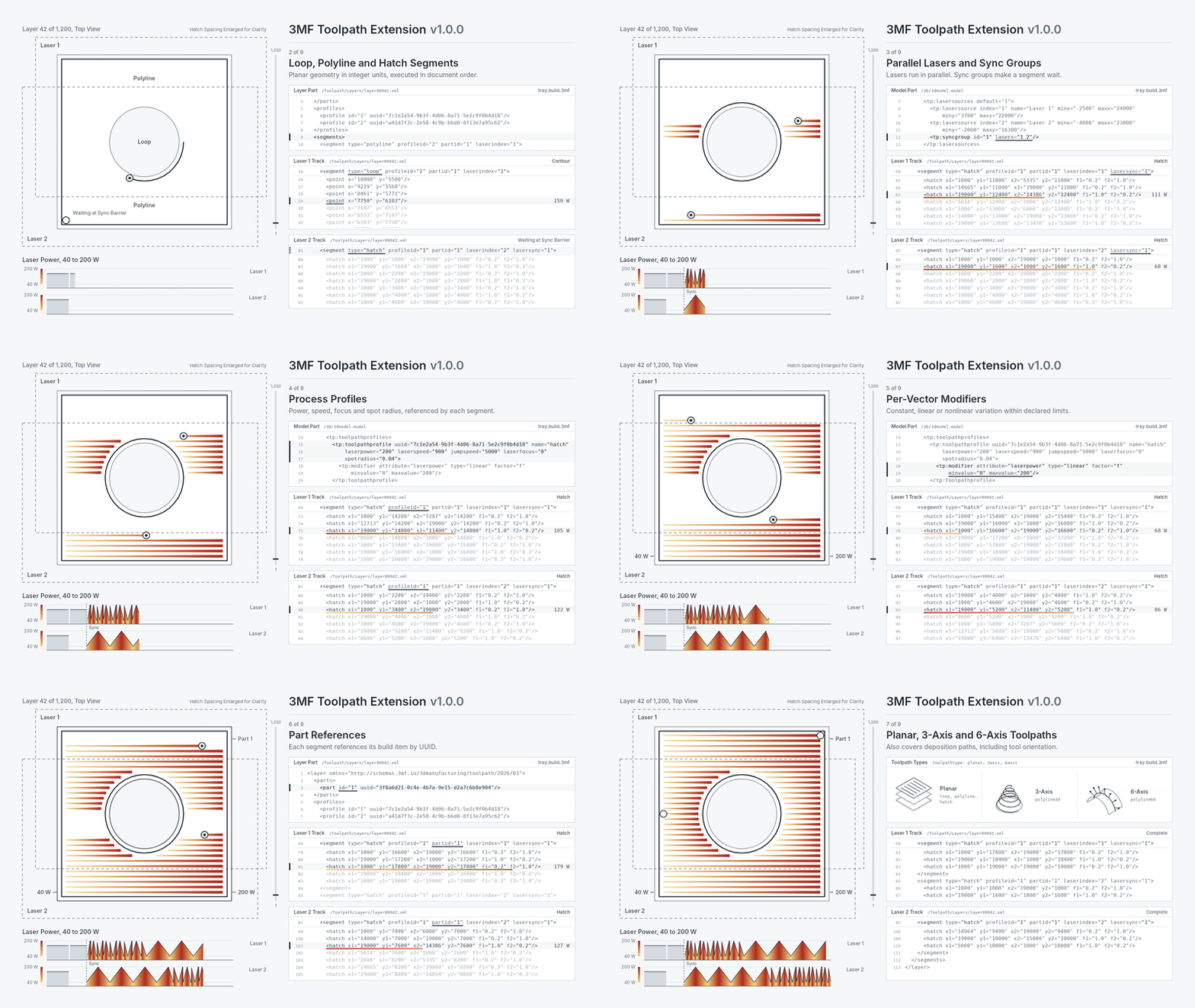
This week the 3MF Consortium released version 1.0.0 of the 3MF Toolpath Extension.
It defines an open, machine-independent way to describe laser build data for laser powder bed fusion and other layer-based processes, stored in the same 3MF package as the geometry it was generated from.
Where the Data Stops
A large share of CDFAM presentations end up at the same point. A team has developed an architected material, a field-driven lattice or a geometry with spatially varying properties. The design intent is precise. Then it has to be sliced, translated into a build format specific to one machine builder, and sent to a printer that receives contours, hatches and a parameter set chosen from a menu.
In that translation the toolpath usually loses its connection to the part, and most of the information that made the design interesting is reduced to whatever the proprietary format can carry. Inspection, simulation and toolpath software all have to be written separately for each format.
3MF has addressed the geometry side of this for some time, which is why it comes up so often in CDFAM talks. The Toolpath Extension carries the same approach down to the individual laser vector.
What the Extension Defines
In short, the extension describes what the laser does:
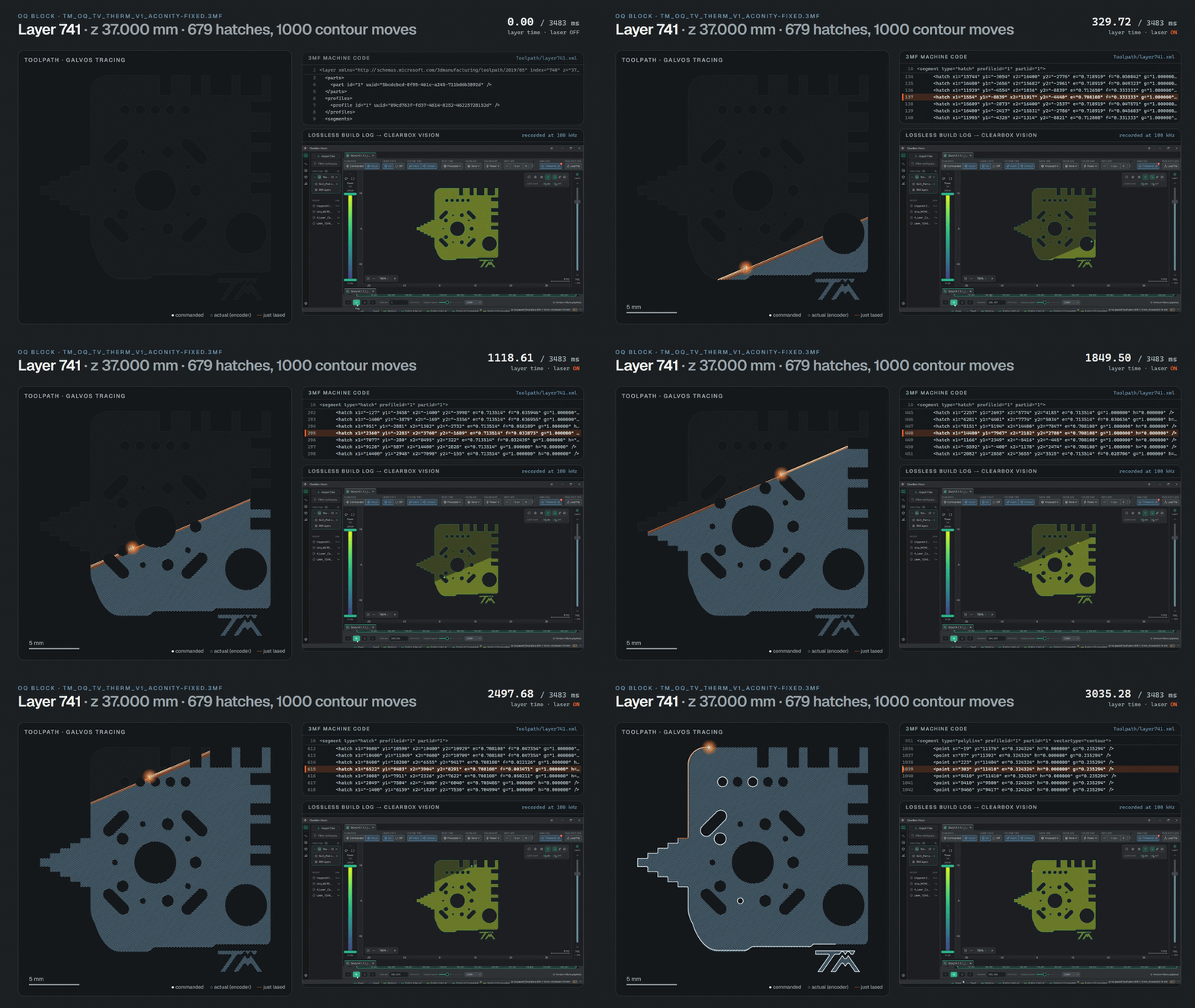
Laser power, speed, focus and spot size in toolpath profiles, with namespaced extensions for vendor-specific parameters
Parameter variation along each vector, constant, linear or piecewise, within declared bounds a machine can check at load time
Microsecond timing for each segment
Multiple lasers, with scan fields and synchronization barriers
A link from every segment to the part it was generated from
Per-layer packaging for random access and streaming of large builds
3-axis and 6-axis toolpaths for deposition and robotic processes
The full specification is on 3mf.io and GitHub.
Two Views From the People Who Wrote It
Alexander Oster, Technical Director of the 3MF Consortium, and Hunter Taylor, CTO of Tailored Alloys, on why the specification matters:
“This gives the industry a common, open representation for state-of-the-art laser processing without being tied to a proprietary ecosystem.”
Alexander Oster, 3MF Consortium
“I see the 3MF Toolpath Extension doing for LPBF what G-code did for CNC. A non-proprietary toolpath format for LPBF will enable inspection to begin before the build, because digital inspection tools will no longer need to be built for machine-specific formats.”
Hunter Taylor, Tailored Alloys
The G-code comparison is a useful one. G-code is not elegant, but it is common, and that commonality is what allowed CAM software and machine tools to develop independently of each other. LPBF has not had that.
What Comes Next
Version 1.0.0 assigns parameters to vectors. The next step is volumetric and field-driven parameter assignment: defining process parameters as a function of position in the part, so the same field that drives a graded lattice can also drive the laser that builds it. For the CDFAM audience that is the more interesting part, and it is now in development.
The Toolpath Extension will also become part of ISO/IEC 25422:2025, the 3MF specification suite.
Thanks
Thanks to Alexander Oster and Hunter Taylor, and to Daniel Reitemeyer at SCANLAB, Alexander Bockstaller and Jan Orend at EOS, Ursa Major, Harshil Goel at Dyndrite, Daniel Driscoll, Kurt Renap at Materialise, Yves Hagedorn at Aconity3D, and everyone else who worked on the specification over the past seven years.
The full announcement, with statements from SCANLAB, EOS, Ursa Major, Tailored Alloys and Aconity3D, is at 3mf.io.