
CDFAM convenes in DC next week. July 15 to 16, Washington DC.
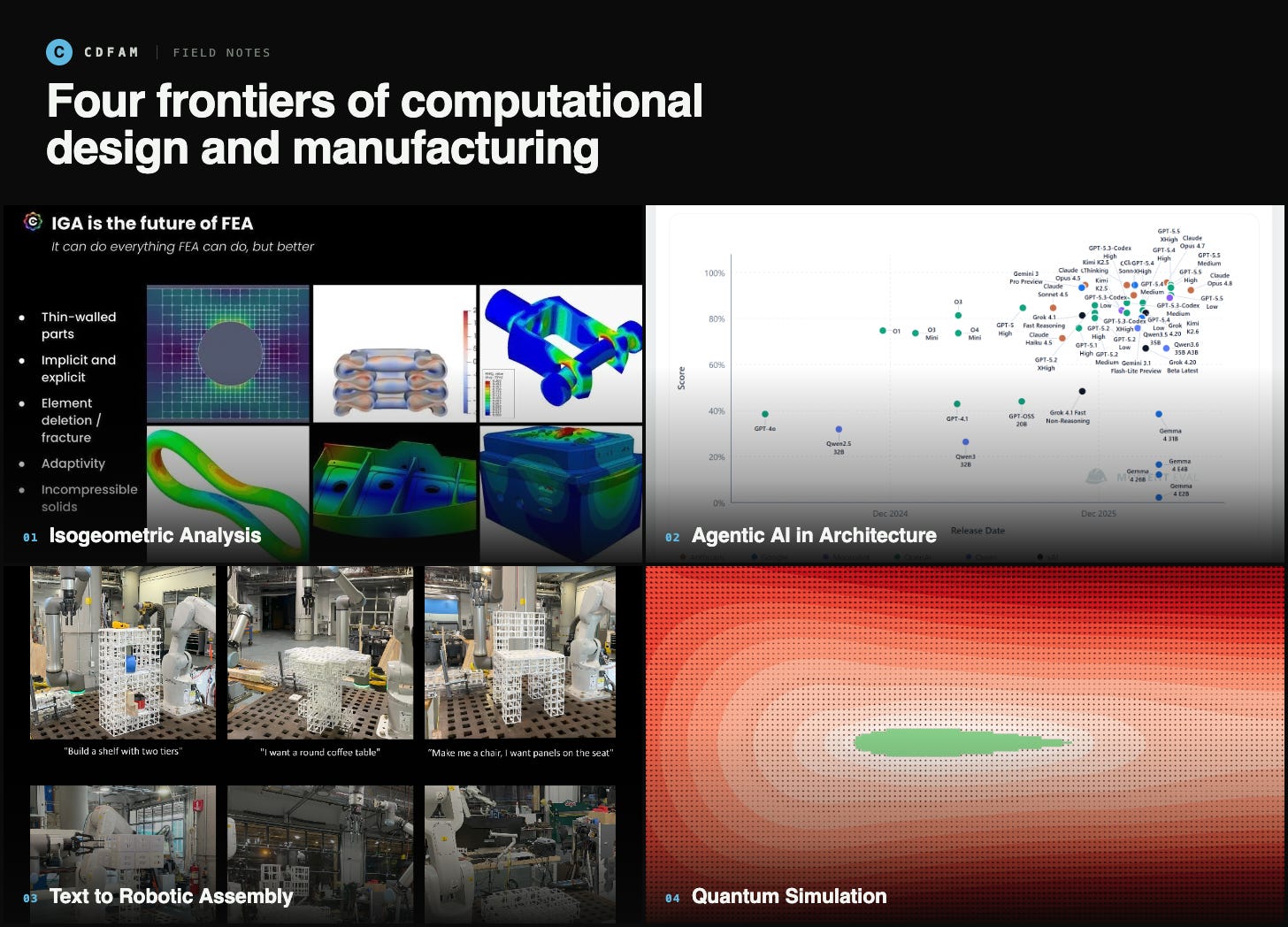
The last four interviews we have published, together with the two keynotes, give a reasonable picture of the breadth and depth of the program.
Isogeometric analysis removing meshing blockers from CAD-to-simulation workflows, agentic AI inside a structural engineering practice, generative design constrained by robotic assembly, quantum algorithms for CFD, AI-generated flight structures at NASA, and the software stack behind humanoid robots at Boston Dynamics.
Six talks, six different points of entry into the same set of problems: how computational tools move from research into production, and what changes when AI/Machine Learning is inserted and accelerates that pipeline.
The evening session moves from the engineering and software detail of the day into policy, with a fireside conversation between Rep. Chrissy Houlahan and Dr. Will Roper and a live UAS redesign demo.
It is DC coming to CDFAM this year as much as the other way around.

Isogeometric analysis, and specifically the removal of manual meshing from CAD-to-simulation workflows. Sederberg’s point is not that IGA is faster. It is that meshing is the step that breaks the link between CAD and everything downstream, including an agent’s ability to reason about a design. Take that step out and the loop closes. Coreform’s approach has been to integrate into Abaqus rather than compete with it, which is its own lesson in where the leverage actually sits.

Sergey Pigach, CORE studio, Thornton Tomasetti.
A return visitor, this time on agentic systems in structural engineering. Pigach is candid that TT is not yet comfortable running fully autonomous agents on real projects, and the interview is mostly about why: auditability, deterministic tooling, and a threat model that treats an agent less like software and more like an insider with legitimate access. Also covers MOMENT, their internal benchmark for how far LLMs get on structural problems with nothing but a calculator and a sandbox.

Generative AI applied to discrete robotic assembly, not text-to-3D. The distinction matters. A mesh that looks right is not the same as an object that can be fabricated, and Htet Kyaw’s work is about building that constraint back in early, rather than treating fabrication as a downstream problem to be solved after the fact.

Quantum algorithms for CFD. Where current quantum hardware actually sits relative to GPU and CPU simulation (behind, and clearly stated as such), what a hybrid classical-quantum workflow looks like in practice, and how IBM and IonQ architectures change the formulation of the same problem.
Four talks. Simulation infrastructure, structural engineering practice, fabrication-constrained generative design, and quantum hardware for physics. That range is the point of the event.
The policy evening. DC is coming to CDFAM this year, not the other way around. The evening session is a free, government-focused program built around a fireside conversation between Rep. Chrissy Houlahan and Dr. Will Roper, alongside a live UAS redesign demo running through Istari Digital, nTop, Arena Physica, C-Infinity, Luminary, and SysGit. If you work in or around defense and aerospace procurement and have not registered for this piece specifically, it is free and it is worth your evening.
Keynotes.

Ryan McClelland, NASA Goddard. Text To Spaceship: Accelerating Mission Development With AI.
McClelland has already demonstrated AI generating optimized flight structures from requirements, lighter and stronger, in days rather than months. The talk covers what it takes to scale that from a single bracket to full payload designs: a secure, cloud-deployed ecosystem of AI-accessible design, analysis, and manufacturing tools, with requirements defined in language flowing through automated systems end to end. Read the interview.

Brian Ringley, Boston Dynamics. Authoring Autonomy.
Ringley’s argument is that hardware capability is not the constraint. Boston Dynamics has the most dynamic humanoid platform available, and that is not enough on its own. The harder problem is the software: brains trained on large data sets rather than programmed, where spatial reasoning cannot be scraped from the internet the way text can. The talk covers the tooling required to close that gap, agentic sandboxes where operators teach robots by physical demonstration, describe tasks in natural language, and refine generative robot behavior directly.
Registration and the full program are at cdfam.com/cd-dc-26.
