In our latest CDFAM speaker interview, we speak with Verena Vogler, architect and computational designer at McNeel Europe, about “Ecological Simulation Framework for Rhino/Grasshopper.”
Her work introduces Rhino.Ecologic, a new ecological simulation framework built for Rhinoceros 3D and Grasshopper that embeds plant community modeling, biodiversity analysis, and biomass simulation directly into computational workflows.

Rather than treating ecology as a downstream validation exercise, Rhino.Ecologic integrates environmental intelligence directly into iterative design processes. Geometry is voxelized, environmental layers are mapped, and stochastic plant population dynamics unfold across yearly time steps, producing structured, ML-ready datasets within the same environment where designers are already working.
As Verena explains:
“Unlike traditional ecological assessment tools that operate as external post-processing software, Rhino.Ecologic embeds ecological simulation directly into parametric modeling workflows, preserving full geometric and data interoperability.”
The framework is currently in alpha testing with more than 100 participants across 60 institutions worldwide, approximately 85% from the AEC industry and the remainder from academia.
Developed by an interdisciplinary team of architects, computational designers, and a computational ecologist, the system bridges ecological science and computational design engineering.
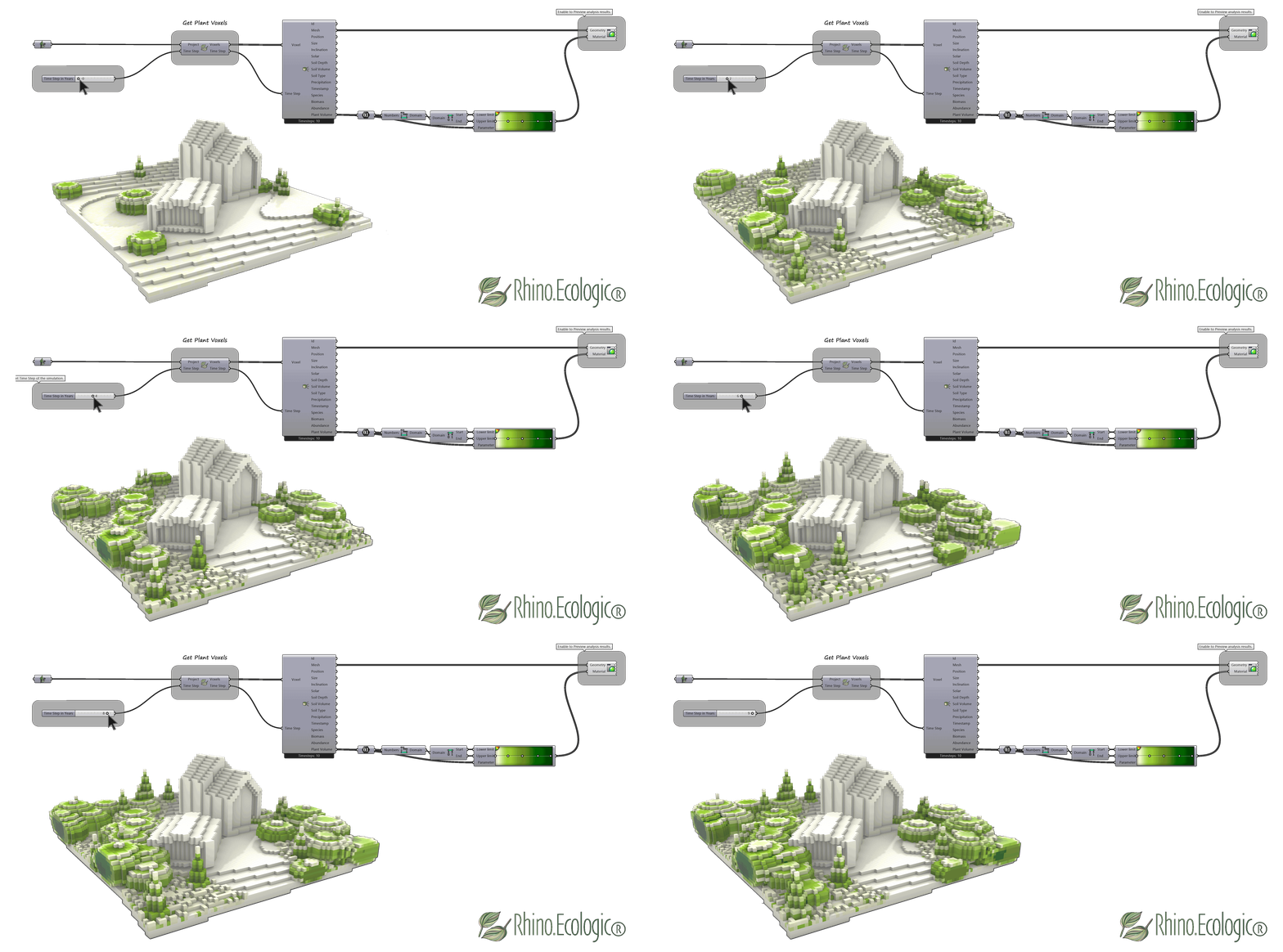
At its core is a shift in mindset:
“In ecological modeling, we do not design individual behaviors directly; instead, we define environmental gradients, resource fields, and interaction rules, and observe how local interactions scale into emergent spatial patterns.”
This approach opens the door to new workflows where biodiversity, biomass, and habitat quality become measurable and dynamic design parameters.
“Rather than assessing environmental impact at the end of a project, we see a future where biodiversity, biomass, and habitat quality become active drivers within parametric workflows.”
In the full interview, we dive deeper into the voxel-based data architecture, the Joschinski Model for plant community simulation, machine-learning integration, and real-world applications, including its use in advanced computational design research at the Architectural Association in London.
Read the full interview on the CDFAM website.
Join us at CDFAM Barcelona to learn more about this work and connect in person with Verena and others advancing computational design, AI and machine learning for engineering and architecture