
Many generative design tools produce geometry and leave manufacturability to be resolved afterward.
Braid Technologies, a Tokyo-based team of around thirty researchers and engineers, has taken the opposite position with AURA, an autonomous engineering system that starts from requirements rather than shape and treats the production process as an input from the first step.
Ahead of their keynote at CDFAM Tokyo, Guido Cossu explains what the company is building, why they began with stamping and casting in automotive and aerospace, and what they mean when they say a machine has actually engineered a part.
Starting from requirements, not geometry
The founding premise is that engineering will not be automated by scaling data alone. Physical design requires learning, physics, geometry and manufacturing knowledge to be solved together, and the result has to be explainable to the engineer who signs off on it.
“The physical world imposes a different standard from text or image generation. An answer cannot merely look plausible. It must obey physics and survive the realities of production.”
The Tokyo presentation is built around a single question: when can we say a machine has engineered a part? Braid’s answer is that design must begin with requirements, physics and manufacturing must be resolved simultaneously, and the output must carry a rationale any engineer can follow.
“We will show why manufacturability cannot remain a correction applied at the end. It has to shape the design at every moment of the generation process.”
Where the engineer sits
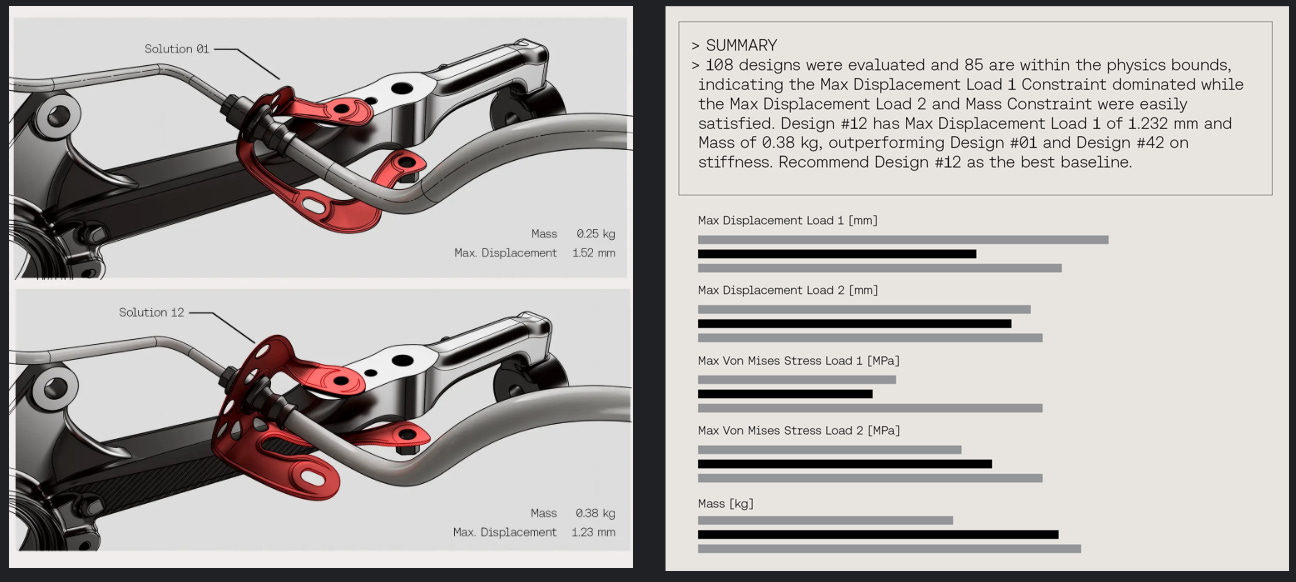
AURA does not remove the engineer. It moves them to defining intent and deciding which tradeoffs matter. Changing a stiffness target, a mass limit or the manufacturing process produces a new design for the revised problem, and each result exposes something about the wider design space.
“When we reduce the time to explore alternatives to hours instead of weeks, exploration can become a normal part of engineering rather than a luxury reserved for exceptional components.”
Why stamping first
Braid deliberately began in high-volume automotive and aerospace, where small compromises in mass or development time compound across many parts and many vehicles, and where a shape the factory cannot make has no value. Stamping is the first process supported in the software product. AURA has also been applied to injection molding and die casting.
The workflow is currently file-based rather than integrated with PLM or PDM. Engineers input standard CAD geometry, material, functional requirements and manufacturing method. AURA returns manufacturable designs in standard CAD formats with an explanation of performance and rationale, which teams verify with their own solvers and approve through existing sign-off processes.
“We want to learn how this community evaluates novelty, captures manufacturing knowledge and builds trust in a part that no person designed feature by feature.”
CDFAM Tokyo, October 8-9, 2026
Braid Technologies is one of 32 speakers presenting at CDFAM Tokyo at the Tokyo International Forum, covering computational design, AI and machine learning for design, engineering and architecture at all scales.