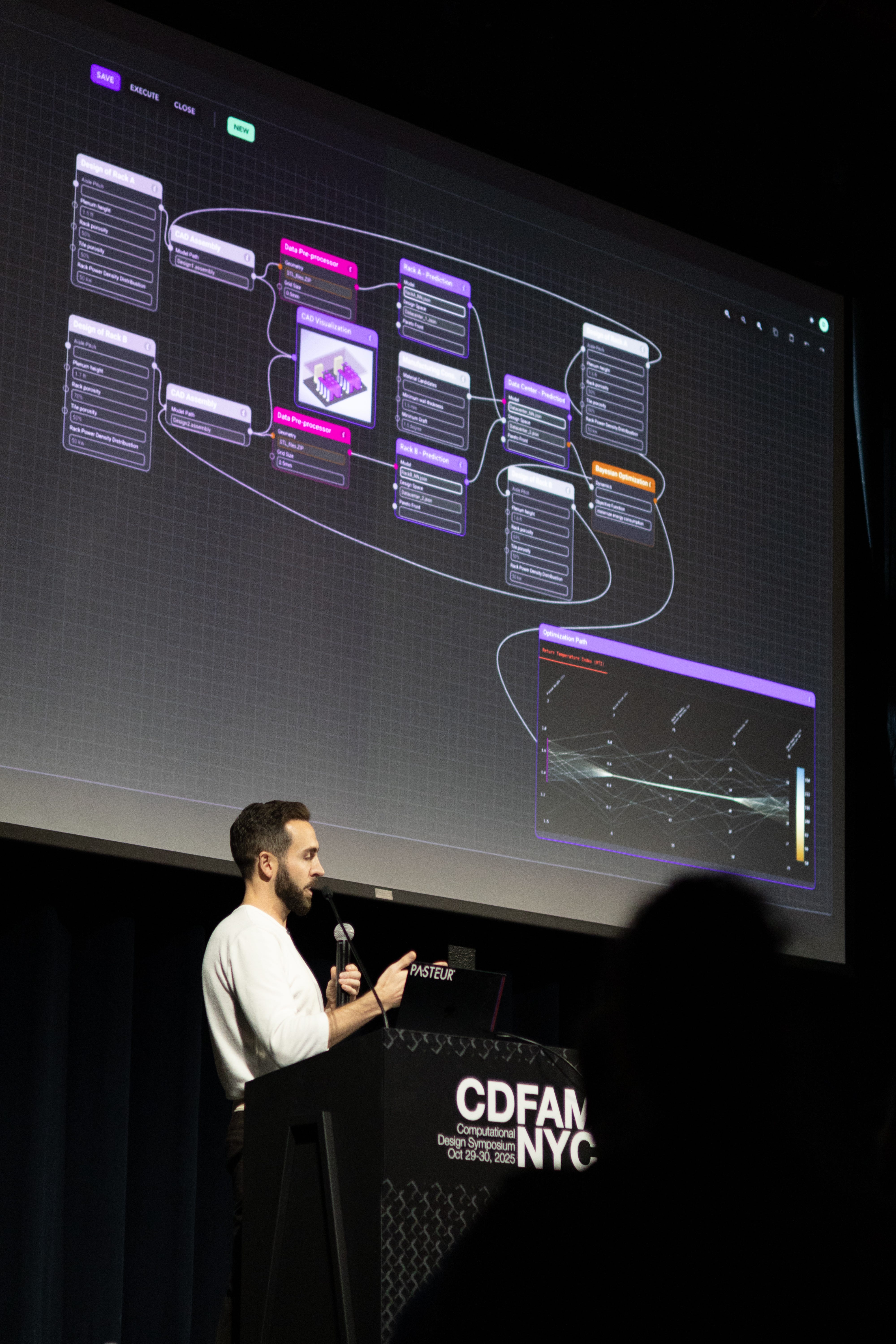
Recorded at CDFAM Computational Design Symposium, NYC, October 29-30, 2025
https://cdfam.com/nyc-2025/
Organization:
Presenter:
The Unreasonable Effectiveness of Simulation Intelligence
Presentation Abstract
Scientific rigor & engineering reliability have always been important yet contentious topics in the AI field. Recent AI trends crank up model sizes, but at what costs? Transparency and verifiability, amongst others that are core to industrial R&D—not to mention the massive spending. These costs are perhaps felt the most in physics simulation and digital engineering. Enter simulation intelligence (SI). SI is not antithetical to AI, rather it is the pragmatic approach to bringing AI capabilities into industrial R&D. Rather than LLMs atop legacy engineering tools or Foundation Models to opaquely replace physics solvers, we look to the combinatorial possibilities available when SI motifs are brought together—namely differentiable physics programming and surrogate modeling, yielding multiphysics modules. This talk will describe the distinction, that is: static CAE simulations vs dynamic simulators, bespoke surrogate models vs flexible multiphysics modules, massive black-box AI vs efficient programmatic SI. Examples from the SI Platform will elucidate end-to-end digital engineering pipelines, in diverse sectors from nuclear energy and data centers, to aerospace and automotive safety.
Speaker Bio
Alexander Lavin is a leading expert in AI-for-science and probabilistic computing. He’s Founder & CEO of Pasteur Labs (and non-profit “sister” Institute for Simulation Intelligence), reshaping R&D with a new class of AI-native simulators, commercializing in energy security, aerospace, materials & manufacturing sectors (
https://simulation.science
). For the last dozen years, Lavin has focused on artificial general intelligence (AGI) research with top startups in neuroscience and robotics (Vicarious, Numenta), and sold his prior ML-simulation startup Latent Sciences to undisclosed pharmaco in neurodegeneration R&D. Lavin also serves as AI Advisor for NASA, overseeing physics-ML efforts for the NASA-ESA “Digital Twin Earth” projects. Previously, Lavin was a spacecraft engineer with NASA and Blue Origin, and won several international awards for work in rocket science and space robotics (including Google Lunar XPrize during graduate studies at Carnegie Mellon). Lavin was named Forbes 30 Under 30 in Science, and a Patrick J. McGovern Tech for Humanity Changemaker
About CDFAM:
CDFAM is a global symposium series at the forefront of computational design, advanced manufacturing, and performance-driven engineering. With a strong emphasis on innovation, CDFAM highlights how leading companies and researchers are leveraging AI, machine learning, and simulation technologies to drive the next generation of design tools, workflows, and digital fabrication methods.
The symposium fosters cross-disciplinary collaboration and knowledge exchange between designers, engineers, and technologists exploring the cutting edge of digital design — from generative workflows.
Past presenters and partners include companies such as NVIDIA, NASA, New Balance, BMW, ARUP, Foster +, Partners, BIG, Autodesk, Dassault Systèmes, nTopology, PyhicsX, Neural Concept, Siemens and more, showcasing how computation and AI are transforming everything from aerospace to footwear.
Learn more at
https://cdfam.com
.